Why WhatsApp Marketing Is Essential for Growing Businesses
In today’s hyper-connected digital economy, businesses across India—from Jaipur to Chennai—are turning to WhatsApp as a primary channel for customer engagement. With over 500 million users in India alone, WhatsApp is no longer just a messaging app; it's a powerful marketing and customer service platform. For growing businesses, leveraging the WhatsApp Business Cloud API offers a direct, personal, and highly effective way to build relationships, drive conversions, and scale operations—without the
Sumit Avasthi
Product Head

In today’s hyper-connected digital economy, businesses across India—from Jaipur to Chennai—are turning to WhatsApp as a primary channel for customer engagement. With a massive user base in India, WhatsApp is no longer just a messaging app; it has become a powerful platform for marketing, sales, customer support, and business communication.
For growing businesses, leveraging the WhatsApp Business Cloud API provides a direct, personal, and scalable way to build customer relationships, drive conversions, automate communication, and streamline operations without relying solely on traditional channels such as email or SMS.
The shift in customer communication is clear: people prefer interacting with businesses through platforms they already use every day. WhatsApp offers businesses immediate access to customers while supporting rich media, interactive messages, automation, and real-time conversations.
For SMEs, IT service providers, e-commerce businesses, manufacturers, and other growing companies, this can mean faster response times, greater customer trust, improved support, and smoother sales experiences—all within one familiar communication channel.
In this guide, you’ll discover how WhatsApp marketing for businesses can transform customer outreach, why the WhatsApp Business Cloud API is valuable for automation and scalability, and how businesses can use WhatsApp to improve customer engagement and retention.
5 Compelling Reasons Growing Businesses Should Embrace WhatsApp Marketing
For modern businesses aiming to scale efficiently while maintaining strong customer relationships, integrating WhatsApp into a digital marketing and customer engagement strategy can provide significant advantages.
-
High Message Visibility and Faster Customer Responses
WhatsApp messages are typically noticed much faster than conventional email campaigns because customers frequently use the app throughout the day. This makes WhatsApp particularly useful for time-sensitive communication such as order confirmations, appointment reminders, delivery notifications, service alerts, and promotional offers.
Faster message visibility can help businesses increase customer engagement, reduce missed communications, and improve conversion opportunities.
-
Direct and Personalized Communication at Scale
WhatsApp enables businesses to create personalized customer experiences using rich media, interactive buttons, lists, dynamic message templates, and automated workflows.
Whether a business is sending shipping updates, service information, product recommendations, or promotional messages, WhatsApp can maintain a conversational experience even when communicating with a large customer base.
This combination of personalization and scalability is especially valuable for businesses operating in competitive markets across Rajasthan and other regions of India.
-
Seamless Customer Support with Less Friction
Modern customers expect quick and convenient support. WhatsApp allows businesses to provide real-time assistance, answer common questions, resolve customer concerns, and share important information within a familiar messaging environment.
Faster support can reduce friction throughout the customer journey, improve satisfaction, and help businesses build stronger long-term relationships.
-
WhatsApp Automation That Still Feels Conversational
Using the WhatsApp Business Cloud API, businesses can automate common customer interactions based on keywords, workflows, customer actions, or backend events.
For example, keywords such as “pricing,” “availability,” “services,” or “track order” can trigger predefined responses containing buttons, lists, text, images, documents, or other supported message formats.
This allows businesses to reduce repetitive manual work while still providing customers with an intuitive conversational experience.
-
Stronger Brand Credibility and Professional Communication
Using the official WhatsApp Business Platform allows organizations to establish a more professional communication presence while following Meta’s business messaging requirements.
Businesses may also qualify for additional verification features depending on Meta’s applicable eligibility requirements and verification programs. A recognizable and trusted business identity can help reduce customer confusion, strengthen credibility, and improve confidence when communicating through WhatsApp.
How the WhatsApp Business Cloud API Powers Modern Customer Engagement
The WhatsApp Business Cloud API enables businesses to move beyond basic messaging and build scalable customer communication systems. Unlike the standard WhatsApp Business App, an API-based solution can be connected with CRMs, databases, support systems, automation platforms, AI solutions, and custom business applications.
This makes the WhatsApp Cloud API particularly useful for businesses managing hundreds or thousands of customer conversations and requiring automation, centralized management, reporting, and workflow integration.
Bulk Campaigns with WhatsApp Policy Compliance
Businesses can use approved message templates to send marketing notifications, transactional messages, reminders, alerts, and service updates to customers who have provided the required consent.
Campaign performance can also be monitored through connected systems, helping businesses evaluate delivery, engagement, responses, and overall campaign effectiveness.
Real-Time Chat for Sales and Customer Support
The WhatsApp Business Platform can be integrated with a custom chat dashboard or customer support interface, enabling sales representatives, support agents, automation systems, or AI assistants to manage customer conversations efficiently.
This is especially valuable for IT service providers, e-commerce companies, service businesses, and organizations handling client onboarding, troubleshooting, sales inquiries, or post-purchase support.
Keyword-Triggered WhatsApp Automation
Businesses can configure automated workflows based on exact or partial keyword matches. For example, when a customer types “services”, the system can automatically display available services. A message containing “support” could initiate a support workflow or ticket creation process.
Automated WhatsApp responses can include:
- Quick-reply buttons
- Interactive lists
- Images and videos
- PDF documents
- Product or service information
- Links and calls to action
- Order or service status information
Integration with Existing Business Systems
One of the biggest advantages of the WhatsApp Business Cloud API is its ability to connect customer conversations with existing business technology.
The API can be integrated with systems such as:
- Customer Relationship Management (CRM) platforms
- ERP and inventory systems
- Customer support software
- E-commerce platforms
- Appointment and booking systems
- Payment and order management systems
- Custom web applications
- AI-powered customer support solutions
These integrations help businesses create a centralized customer communication workflow and reduce the need for employees to switch between multiple disconnected systems.
WhatsApp Business App and API Coexistence
Depending on the available WhatsApp Business Platform configuration and eligibility, businesses may be able to maintain workflows that combine manual conversations with API-powered automation.
This can provide teams with greater flexibility by allowing employees to manage certain conversations manually while automated systems handle repetitive queries, notifications, and workflow-based communication.
Secure and Scalable Cloud Infrastructure
Businesses building solutions around the WhatsApp Business Cloud API can connect the platform with secure and scalable backend infrastructure hosted on services such as AWS, Azure, Google Cloud, or other trusted cloud providers.
Technologies such as application servers, databases, load balancing, monitoring, backups, encryption, and access controls can be used to create reliable communication systems capable of supporting increasing message volumes.
By adopting the WhatsApp Business Cloud API, growing businesses can transform WhatsApp from a simple messaging channel into an integrated platform for sales, marketing, customer service, notifications, and automation.
Frequently Asked Questions About WhatsApp Marketing and the Cloud API
Why should my business use WhatsApp for marketing instead of email or SMS?
WhatsApp provides businesses with a highly accessible communication channel that customers frequently use throughout the day. It also supports interactive buttons, images, videos, documents, and conversational communication, making it useful for marketing campaigns, sales conversations, customer support, reminders, and transactional notifications.
Can I automate customer responses on WhatsApp?
Yes. Using the WhatsApp Business Cloud API, businesses can build automated responses triggered by customer messages, keywords, workflows, CRM events, or other business logic.
For example, customers entering phrases such as “pricing,” “services,” “hours,” or “track order” can automatically receive relevant information, buttons, lists, media, or workflow options.
Is WhatsApp marketing suitable for B2B businesses?
Yes. B2B businesses can use WhatsApp for lead communication, client onboarding, appointment scheduling, project updates, service confirmations, document sharing, payment reminders, technical support, and ongoing account communication.
The speed and convenience of WhatsApp make it particularly useful for businesses that need regular communication with clients and partners.
How does the WhatsApp Business Cloud API differ from the WhatsApp Business App?
The WhatsApp Business App is primarily designed for smaller businesses managing conversations manually through a mobile or desktop interface.
The WhatsApp Business Cloud API is designed for businesses requiring greater scalability, automation, integrations, multi-agent workflows, CRM connectivity, and custom business processes.
Can I send WhatsApp marketing messages to customers who have not contacted me first?
Businesses must follow WhatsApp’s applicable messaging and consent policies. Promotional communication should only be sent to users who have provided appropriate opt-in consent.
Businesses can collect WhatsApp marketing consent through website forms, QR codes, landing pages, checkout processes, advertisements, click-to-WhatsApp campaigns, or other clearly disclosed opt-in methods.
Does WhatsApp support file sharing and media in business messages?
Yes. WhatsApp Business messaging supports multiple content formats, including images, videos, PDFs, documents, and interactive message elements where supported.
Businesses can use these formats to share product catalogs, quotations, invoices, brochures, service guides, onboarding documents, tutorials, and other useful customer information.
How secure is customer data when using the WhatsApp Business Cloud API?
Businesses should implement appropriate security controls across their entire WhatsApp integration, including secure authentication, encryption, access management, database security, monitoring, backups, and compliance processes.
When connecting WhatsApp with external CRMs, databases, cloud infrastructure, or custom applications, organizations remain responsible for securing the systems and customer information they control.
How to Build an Effective WhatsApp Marketing Strategy
Successful WhatsApp marketing is not simply about sending more messages. Businesses should focus on delivering useful, relevant, and timely communication that improves the customer experience.
Define Your Primary WhatsApp Use Cases
Begin by identifying the customer interactions that would benefit most from WhatsApp. Common use cases include:
- Sales inquiries and lead qualification
- Customer support
- Appointment reminders
- Order and delivery notifications
- Payment reminders
- Customer onboarding
- Product or service promotions
- Feedback collection
- Technical support
- Customer retention campaigns
Use Automation for Repetitive Conversations
Identify frequently asked questions and repetitive customer requests that can be automated. Keyword-based responses, interactive menus, chatbots, and workflow automation can significantly reduce manual workload while giving customers faster answers.
Integrate WhatsApp with Your CRM
Connecting WhatsApp with a CRM enables businesses to maintain customer history, track leads, assign conversations, record interactions, personalize communication, and create automated follow-up workflows.
Segment Your WhatsApp Audience
Avoid sending identical promotional messages to every customer. Segment contacts based on interests, purchase history, location, customer lifecycle stage, service requirements, or previous engagement.
Better audience segmentation can make WhatsApp marketing campaigns more relevant and improve the overall customer experience.
Prioritize Customer Consent and Message Quality
Customer trust should remain central to every WhatsApp marketing strategy. Clearly communicate what users are subscribing to, obtain appropriate consent, provide useful content, avoid excessive messaging, and respect requests to stop receiving promotional communication.
Start Building Deeper Customer Relationships with WhatsApp
WhatsApp marketing has become an important communication strategy for growing businesses that want to remain responsive, accessible, and connected with their customers.
With the WhatsApp Business Cloud API, businesses can automate customer engagement, personalize conversations, integrate communication with existing systems, and scale customer support without sacrificing the conversational experience customers expect.
Start by defining your core messaging use cases—whether they involve sales, customer support, reminders, order updates, or promotions. Implement automation for repetitive conversations, connect WhatsApp with your CRM or business systems, and continually optimize your workflows based on customer behavior.
Whether you operate an IT services company, e-commerce business, manufacturing company, local service business, or growing enterprise, WhatsApp can provide a direct and convenient channel for building stronger customer relationships.
By combining thoughtful communication with the scalability of the WhatsApp Business Cloud API, businesses can create faster, smarter, and more personalized customer experiences—one conversation at a time.
Related Tags
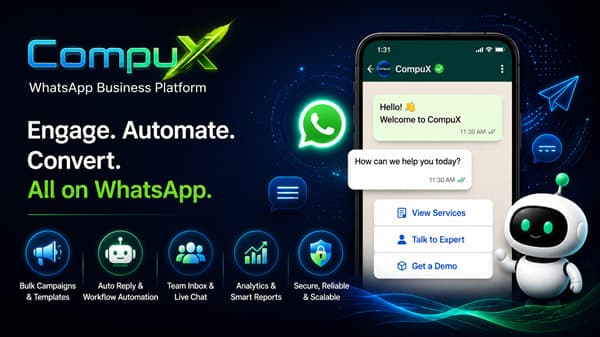
Automate Your WhatsApp Business with CompuX
Connect your WhatsApp Business account with official Cloud API, launch broadcast campaigns, and streamline customer support today.